Posts

Saving Maud

Image
Bringing it Back to Marshalltown, rug hooking, Laure Kenne y     Marshalltown Road, oil on masonite, Steven Rhude     "As long as I've got a brush in front of me, I'm alright." - Nova Scotian folk artist Maud Lewis    Maud Lewis makes this defiant statement at the end of the CBC documentary 'Folk artist Maud Lewis at work in her Nova Scotian home' . [1] In the 1965 profile, CBC's Telescope  introduces viewers to the artist and her husband at work in and around their house, and speaks to friends and supporters. It frames Maud and Everett Lewis as anti modernists caught up in the wake of a nostalgic view from the Digby region of a province rapidly embracing changes that came with modernism and the respective economic circumstances influencing rural existence at the time. Aggressively putting Nova Scotia history and folk culture in the shop window for all to see became a government strategy fully illuminated by the work of folk artist...

Roxanne rows to Abbozzo Gallery

Image
Roxanne Rowing off Canso During WW2, oil on canvas, 52" x 32". Steven Rhude Abbozzo Gallery, Toronto: In honour of Canada Day and the 150th anniversary of Confederation, we’ve mounted an exhibition in the Main Gallery and The Project Room featuring art work by our artists from across the country, representing different areas of Canada, and sometimes art work that just has the colour red!  http://abbozzogallery.com/confederation-150/  

LOCAL XPRESS

Image
Recent article in the Local Express https://www.localxpress.ca/local-arts-and-life/monet-meets-the-maritime-buoy-in-steven-rhudes-new-exhibit-632214 Steven Rhude, Wolfville, NS

de Chrico's Voyage

Image
de Chirico's Voyage, oil on masonite, 24" x 20", Steven Rhude "In the neighborhood I grew up in, people did not spend time outside their houses. I often played games as a child that centered around life after a neutron bomb. I would imagine I was the only person left alive; solitary, playing with my Hula-hoop in the driveway; the TVs flickering through the windows of houses nearby were simply remnants of a lost civilization. If I walked into one, I’d find a skeleton sitting in a La-Z-Boy bathed in the glow of The Price Is Right ."  - Cara Hoffman https://www.theparisreview.org/blog/2017/03/06/vanishing-point/ Steven Rhude, Wolfville, NS  

Monet's Moment

Image
Monet's Moment, oil on masonite, 24" x 24", Steven Rhude "For me, a landscape does not exist in its own right, since its appearance changes at every moment; but the surrounding atmosphere brings it to life - the air and the light which vary continually. For me, it is only the, surrounding atmosphere which gives subjects their true value." Claude Monet (1891); as quoted in: National Gallery of Australia, ‎Michael Lloyd, ‎Michael Desmond (1992), European and American paintings and sculptures 1870-1970 in the Australian National Gallery, p. 75

The Cipher

Image
Matisse's Blue Cipher, oil on masonite, 14" x 12", Steven Rhude To Shear: 1. To remove (fleece or hair) by cutting or clipping. 2. To remove the hair or fleece from. 3. To cut with or as if with shears: shearing a hedge. 4. To divest or deprive as if by cutting Even though it makes a good story that the aged Matisse turned to cut outs as illness struck, it is known that he first experimented with the concept in the 1930's. However, "drawing in space", as Matisse called it, suggests a code or disguised form of expression, and with a pair of tailor shears it is nothing short of enchanting as his late work involved large hand painted coloured papers, cutting, pins, and the flux of compositional manuvering.  Steven Rhude, Wolfville, NS

Dreams

Image
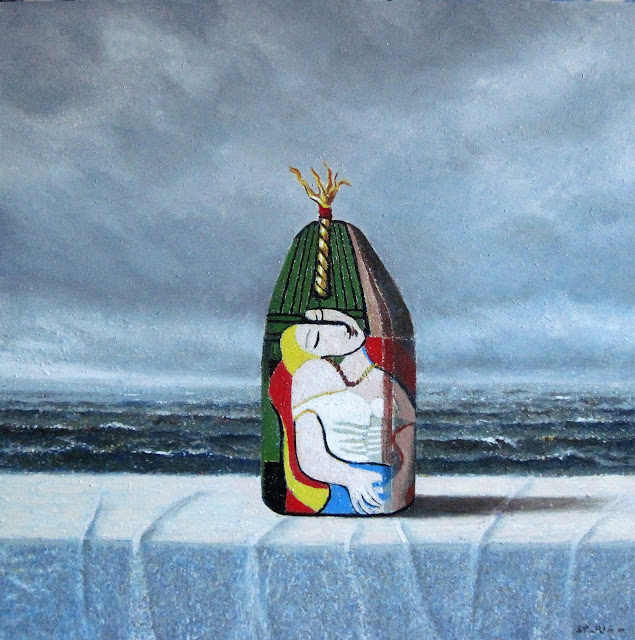
Picasso's Dream, oil on masonite, 24" x 24", Steven Rhude Picasso in many respects was one big dream, or nightmare depending on how one views his art and time, and his various artistic periods. Picasso's portrayal of contemporary man and his wars, was very much the story of man's inhumanity to man with little time to consider the consequences of his actions, or spiritual decline. Carnality for Picasso was the antidote.  Dreaming turbulently, mirroring an image of the twentieth century, Picasso's world was deeply inhabited by those women he seduced and transformed into his muses, consuming them until his creativity was almost exhausted, enough so that a new muse was needed to enable the dream to continue, and so making their dreams into his dream as the cycle of the artist/model manifested. The muse for Picasso's "The Dream" was Marie-Thérèse Walter whom he met when she was seventeen and he in his forties. In 1977, four years after Picas...