Posts

Custer's Head Road (Water Woman)

Image
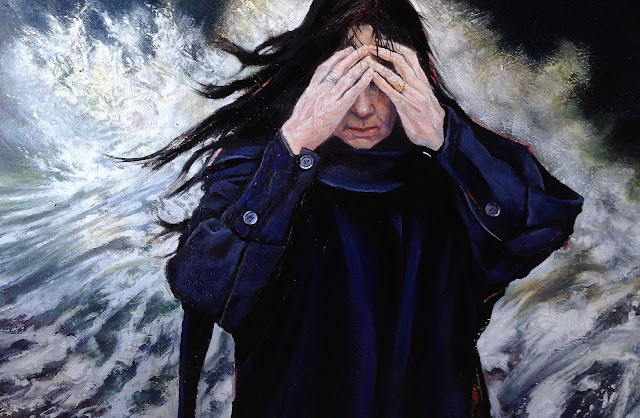
                                            Custer's Head Road, oil on canvas, 40" x 90", Steven Rhude     Timeline Hant's Harbour 1697 – Abbe Baudoin reports that there are four houses at Hant's Harbour. 1801 – Five families are listed as living in Hant's Harbour. 1813 – T.E. and Mary Pelley die. The gravestone recording this still stands. 1820s – The first known church is built in the community. 1830s – The population consists of 400 people. 1847 – Ten vessels carrying 271 men are engaged in the  seal hunt . 1853 – Eight vessels totaling 767 tons carry 294 men to the seal hunt. 1868 – 1870 – A second and much larger church is built, serving the circuit until 1907 when it is destroyed to build a new one. 1871 – Lovell's Newfoundland Dictionary lists 81 of the 104 householders in Hant's Harbour as fisherman. Two others are listed as farmers. 1880s – The population...

Ocean Rose

Image
  Two recent works in a series of florals and the sea.                                                               Ocean Rose, oil on masonite, 23.5" x 19", Steven Rhude                                          Tulips and Buoy, Atlantic Spring, oil on canvas, 40" x 30", Emma Butler Gallery

Man on a Boat

Image
  "You may think that the equation is 'boat and water.' It's not. It's 'money and boat.' The water is not really necessary. That's why you see so many boats in backyards." E.Annie Proux - The Shipping News                                          Man on a Boat, oil on masonite, 26.5" x 17", Steven Rhude My first memory of being on a boat was as a four year old. My aunt and uncle were on their way to view a cottage on an island in the Kawartha Lakes in Ontario. The day was cold and overcast as I hid under the bow of a open cedar strip smacking along choppy waters. I didn't escape my wooden prison until we pulled into a boathouse smelling of engine fuel and moldy jackets. The cottage was acquired and later in the summer my image of the boat changed after being woken from my bunk at midnight to a full moon, and then to be blanketed and paddled around a lake as smooth as glass in or...

Great Auk - Henry Drummond's Vision

Image
The Great Auk's ghost rose on one leg,  Sighed thrice and three times winkt,  And turned and poached a phantom egg  And muttered,  "I'm extinct." Ralph Hodgson  1871 - 1962                        Great Auk (Henry Drummond's Vision), oil on masonite, 20" x 20", Steven Rhude Colonel H. M. Drummond was a highly respected Ornathologist. In December 1852, eight years after the Great Auk was supposedly extinct, Henry was sailing home for Christmas. Good old Henry spotted what he thought was a Great Auk off the coast of Newfoundland. The following year a dead bird was allegedly found washed up on the shores of Trinity Bay on the eastern side of Newfoundland. This account is from Eric Fuller's book The Great Auk. Science has little patience for ghosts, and Henry had no camera or an eye witness to back up his claim - only his word and his vision. I on the other hand, had a great specimen skeleton from the Rooms ...

From Red Head Cove

Image
                                                       From Red Head Cove, oil on canvas, 30" x 64", Steven Rhude He was born in the Cove. They said he was tough as boiled owl. They were right, but from my own perspective, I saw a different individual. Admittedly, more than one brawl provided a brick or two to his reputation as a solid wall of community respect - but he was young back then. He did a number of things to earn his keep and he was feared no matter what the job was. Once he went shrimping to Greenland and  told a crew member who was praying on his knees in the wheel house during a life or death storm, to "get back to your post." If you crossed him it was wise to leave town, if you were his friend you could sleep at night knowing your traps were safe.  As a young man he divided his time between the boat and the fish plant up the...

Black Dog

Image
 Black Dog in Spring Field, oil on masonite, 12" x 14" Wikipedia (folklore) suggests that a black dog is a supernatural, spectral, or demonic entity originating in English folklore covering Europe and the Americas. They have been regarded as sinister and malevolent, connected with the devil - an omen of death, and the incarnation of the hellhound. The above painting is a bit of an oxymoron since the subject "Hagrid" is not in the spring of her life, but rather the autumn. She was acquired by me about fifteen years ago as a gift for my son; a transaction made outside the confines of collective domestic acceptance. However, it all worked out in the end. I never found her malevolent or demonic. She always greeted people with a bark, an energetic wag of the tale, and a humble countenance. It was only on a few rare occasions that she expressed caution or even raised the alarm with an individual. Ironically those individuals were dressed in long black coats out on the Wol...

The Ballad (Curse) of Betsy Publicover

Image
   Years ago, or in one of those 'time out of mind' nights, on the furthest most easterly point of mainland Nova Scotia , Canso poet and dear friend, June N. Jarvis, told me of a tragic, painful, and sad poem she wrote. It's a poem with vengeance and a curse that starts when a young woman is as they say - led astray by a young man. It's about the days of yore, the sea and all the allegory it represents. It's about a woman's decent into supernatural darkness and the August gales that accompanied her.  This is a familiar story in the sense that it is tied to the very nature of folklore, yet like all memorable folklore, it still has a powerful resonance to contemporary times. It entails, a young woman and sex, the passage of time, fishing commerce, a Canso ship in distress, the loss of Betsy's seventeen year old daughter to the sea, and the inability to console, where reparations are like gulls uselessly screeching in a tempest. It is a tale that is...