Posts

Acadien Field Corn

Image
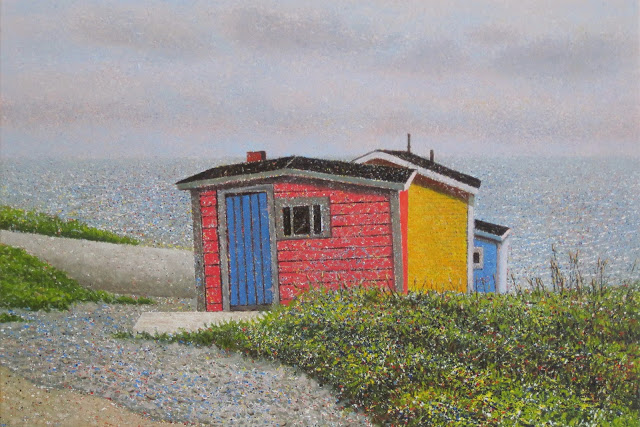
Acadien Lune, oil on canvas, 24" x 30", Steven Rhude When they realized that corn could be grown successfully, it proved to be a blessing to their existence due to its varied uses. Corn could be made into hominy, grits, and cornmeal. The corn shucks were used to make dolls, mattresses, hats, and brooms.  It was also used to smoke out mosquitoes. Dampened corn shucks were braided into rope and used for chair seats and hats. Cobs were used for stoppers and as kindling for fires. - The Acadien Village Venus de l'Acadie, oil on board, 24" x 24", Steven Rhude Steven Rhude, Wolfville, NS

Embodiment

Image
Make and Break Harbour (tri-image), oil on canvas, 36" x 60", Steven Rhude "as soon as each hour of one's life has died, it embodies itself in some material object as do the souls of the dead in certain folk stories, and hides there. There it remains captive forever, unless we should happen on the object, recognize what lies within, call it by its name, and so set it free." Marcel Proust, By way of Saint - Beuve (translated by Sylvia Townsend Warner) Steven Rhude, Wolfville, NS

Quinlan's Oar

Image
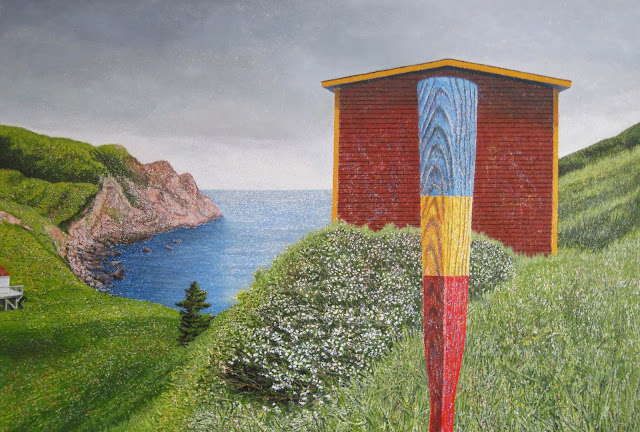
Quinlan's Oar, Red Head Cove, o/c, 34" x 53", Steven Rhude As I see it, there is a modern vitality of shape and form to the boat and oar, the buoy, the shed, and the lighthouse. Qualities both abstract and figurative. Ironic, since these objects predate modernism by centuries. So in them, there is a sense of the minimal before the minimalist. Modern before the modernist. Formal before the formalist. Their maker’s intent wasn’t to create something beautiful; more like something utilitarian. However, it just so happens their intent was beautifully realized. Steven Rhude, Wolfville, NS

Sibley's Cove

Image
Sibley's Cove, oil on canvas, 19" x 28", Steven Rhude Origin of the word Population late 16th century (denoting an inhabited place): from late Latin populatio(n-), from the verb populare, from populus 'people'. Sibley's Cove, Avalon Peninsula, Newfoundland Sibley's Cove is usually considered to include Torquay (pronounced tarquay), a cluster of houses on the East End of the cove. It is believed that the cove was probably named after a migrating fisherman. 1874 – Sibley’s Cove (combined with Lead Cove) first appears on the Census with a population of 61. 1884 – The population is listed as 93. 1891 – One vessel leaves Sibley’s Cove for the Labrador Fishery. 1895 – The first school is built and kept by Isaac March of Brownsdale. 1899 – A Methodist Chapel is built. 1942 – An Orange Hall is constructed. 1957 – A government wharf is constructed for the inshore fishermen. 1992 - Newfoundlanders protest Cod Moratorium 2011 - The population of S...

Leaving Lead Cove

Image
"It's not down on any map; true places never are." - Herman Melville, Moby Dick Leaving Lead Cove, oil on canvas, 19" x 28", Steven Rhude The aesthetic of many a contemporary opinion is often couched in opposites. The Newfoundland landscape and its romantic depiction for instance, may be seen as an infectious blight for some. Typified as comforting images of the landscape, artists and viewers are often bombarded with, and marginalised by, the generalisation of what may or may not be the "quintessential" expression of their land.  For some, the depiction of a lone granite rock (erratic) on a windswept barren, could be seen as quaint; a well trodden subject offered up as comfort food at the expense of tougher subjects like power lines or satellite dishes. My experience is that this view is at best antiquated. Anyone who has walked some barrens in Newfoundland should understand the gravitational pull of something ancient with resonance. Icons...

Lost in the Harbour

Image
 Lost in the Harbour, Watercolour, 22" x 30", Steven Rhude Lost in the Harbour Over here the ladies all want sweet perfume But there's never a rose And over there the roses are frightened to bloom So they never can grow And over here they need wool For weaving their baby's new clothes But nobody has any wool And the sheep are all lost in the harbour Lost in the harbour And over here they want diamonds to wear But there aren't any here And over there everyone's hiding their tears But they're crying inside And the wall won't come down Till they're no longer afraid of themselves And if you don't believe me ask yourselves And then I can come down to the harbour Down to the harbour And then I will fill the ocean back up with my tears I still have a couple more years And then I can come back to the harbour Down to the harbour Lyrics - Tom Waits http://www.youtube.com/watch?v=ohNfC6-GFzU

Night After a Hurricane

Image
Hurricane, 20" x 30", watercolour, whereabouts unknown They took the ferry over to PEI for a show. It was December and a winter storm set in. It was a strange opening (that's what they call an event where people gather to look at art, but really don't). It felt more like a closing. It was a strange mixture of people. They were on a winter island renowned for tourists, with no tourists around. He recalled a nun at the opening who openly enjoyed the Hurricane painting. She said it did that "you know what" to her. Then she blushed. So did he. It was the night when he met Joseph Sherman - the poet, and editor of the defunct  Arts Atlantic magazine . He knew he was a tireless promoter of maritime art and artists. It was also a grumpy night for Joe. And it was also uncomfortable for all present when Joe openly lambasted representational art, old conservative Realism, and the desire to convey a concept or idea with a pictorial objective. T...